

Current Grid Infrastructure Can Support Another 100 GW of Data Centers - And We Can Do It By 2028
A Framework for Data Center Interruptible Service Contracts

This article is a collaborative effort by Peter Hirschboeck and Brian Lithen representing views from impactECI
The digital economy is getting pinched at transmission lines and substations across America. While artificial intelligence and cloud computing demand grows exponentially, our electrical grid has become the ultimate chokepoint, creating a crisis that threatens to derail the next wave of technological innovation.
The numbers tell a stark story: data center interconnection queues have exploded to over 134 GW, based on Wood Mackenzie research1. The capacity in all load interconnection queues is the equivalent of 1.5x the size of ERCOT2. At the same time, average connection times have risen to 8+ years in some regions.
Much of the challenge lies with how data centers have historically interacted with utilities – They would ask for, and receive, firm capacity from two transmission paths. These contracts would allocate power to end users 24/7/365, regardless of whether the customer needed 100% of the contracted load or if grid conditions are normal, strained, or operating with some limited outages.
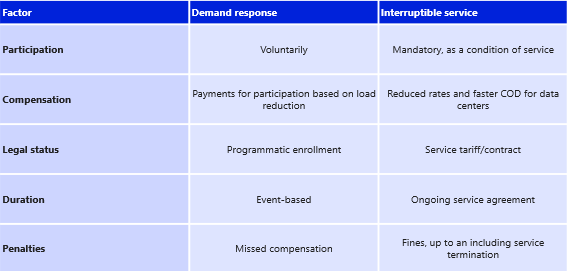
But there's a solution hiding in plain sight. Utilities have successfully used alternative load service contracts that do not guarantee 100% firm supply with industrial customers for decades. Forward-thinking grid operators are beginning to deploy similar contracts for data center customers: Interruptible service contracts. Rather than requesting 24/7/365 service, which may trigger costly grid upgrades for utilities, interruptible service contracts may avoid these upgrades. Under an interruptible service contract, a customer receives electric service with some benefit (usually reduced rates), but agrees to temporarily reduce their power usage, partially or fully, during peak demand periods or grid emergencies whenever requested by the utility. Participation is mandatory as a condition of service, and curtailment events are defined by contract terms, unlike voluntary traditional demand response programs.
Interruptible service would therefore allow data centers to reduce the waiting time for grid connections (replacing reduced rates as a benefit) by accepting seasonal curtailment obligations during periods where these are significant challenges to capacity. It's a win-win-win proposition: Data centers interconnect in months rather than years, while utilities optimize existing infrastructure without costly upgrades, and other customers won’t see higher bills or new, disruptive, and unnecessary transmission projects.
The Grid Connection Crisis and Opportunity
The scale of the current interconnection crisis is massive. CenterPoint Energy (TX) reported a 700% increase in large load interconnection requests, growing from 1 GW to 8 GW between late 2023 and late 20243.
PJM Interconnection, which manages the largest grid in North America, has seen network upgrade costs increase 727% between 2019 and 2022, from $29/kW to $240/kW, an 8x increase that reflects the strain on transmission infrastructure4 5.
During peak hours, the grid simply doesn't have enough available transmission and substation capacity to serve all the new 24/7 demand without major infrastructure investments. Think of a highway system as a proxy for transmission network. Most of the time, roads are clear and there are no major issues – Not many people would say we need many more highways. However, there are a handful of hours where the roads are totally clogged because the amount of traffic is near, at, or above the design capacity for the roadway. A similar phenomenon happens with our electricity grid; peak demand constraining systems is not frequent and intraday usage pattern and weather variations dramatically affect the grid.
Unfortunately, the current preferred solution to the infrequent peak system load challenge to build new transmission lines: A process requiring 5-10 years from planning to energization. Systems shouldn’t plan for around-the-clock peak capacity when only a few hours annually are the concern.
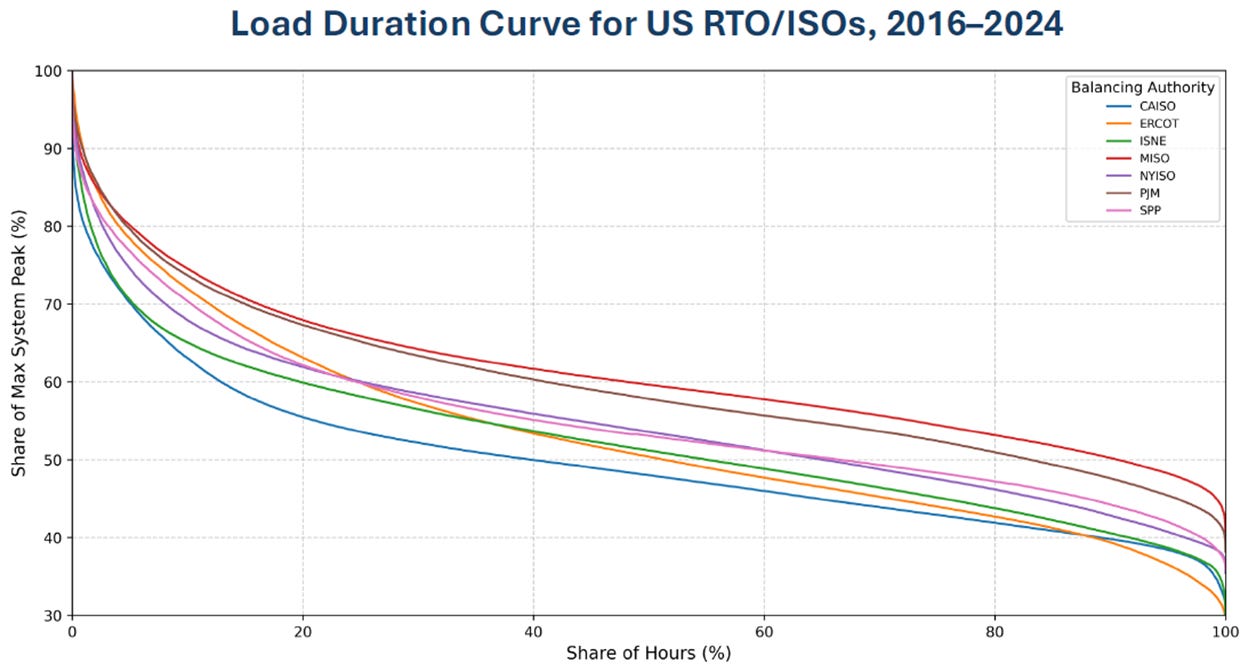
The recent report6 from my friend Tyler Norris and the team at Duke University’s Nicholas Institute shows this concept below. If the 5-10% of the hours causing most of the pain can be managed, US grids will have 15-35% of curtailment-enabled headroom. The 15% figure represents 114 GW based on the US system peak of 759 GW on July 29, 20257.
Interruptible Service Contracts: The Fast-Track Solution
Instead of guaranteeing uninterrupted power 24/7/365 (a.k.a. firm capacity or power), utilities can offer data centers expedited connection in exchange for accepting curtailment during peak demand periods. Most utilities only experience serious grid constraints a couple dozen times a year, challenging the longstanding practice of uninterrupted power for data centers.
The concept isn't theoretical – utilities have successfully operated interruptible service for large industrial customers for decades, with thousands of megawatts currently enrolled in such programs across North America.
The mechanics are straightforward. Data centers seeking to interconnect could request interruptible service from a utility or grid and agree to accept interruption of their load when required, according to clear, fair, and predictable rules. This way, a data center can plan mitigation measures with generation, storage, or load reduction. It should be easier than it sounds, as data centers typically utilize only 40-80% of contracted capacity that utilities reserve for them8, with AI data centers potentially contracting more.
Interruption events typically come during two seasonal curtailment periods, December through February and July through September, aligned with peak heating/cooling nationally. During these windows, utilities can call for load reductions with advance notice.
Customer load interruption and any response is technology-agnostic. Data centers can meet their obligations without reducing the facility load through the use of backup diesel generators, natural gas units, and/or battery energy storage systems. If they are not willing to use generation or storage, they can reduce facility load by shifting IT loads to other facilities or deferring loads to later periods; in many cases, data centers can release some of the capacity they’ve reserved, but don’t actually use, back to the utility9. This flexibility transforms what might seem like a liability into an operational opportunity.
The Framework: Six Critical Requirements
Each utility and each market are different. They have their own unique program development ideas, but there are generally 6 key components that effectively and fairly accomplish the goals of an interruptible service contract with its required curtailable load counterpart. Below we outline these requirements and some suggested values and forms for each to take.
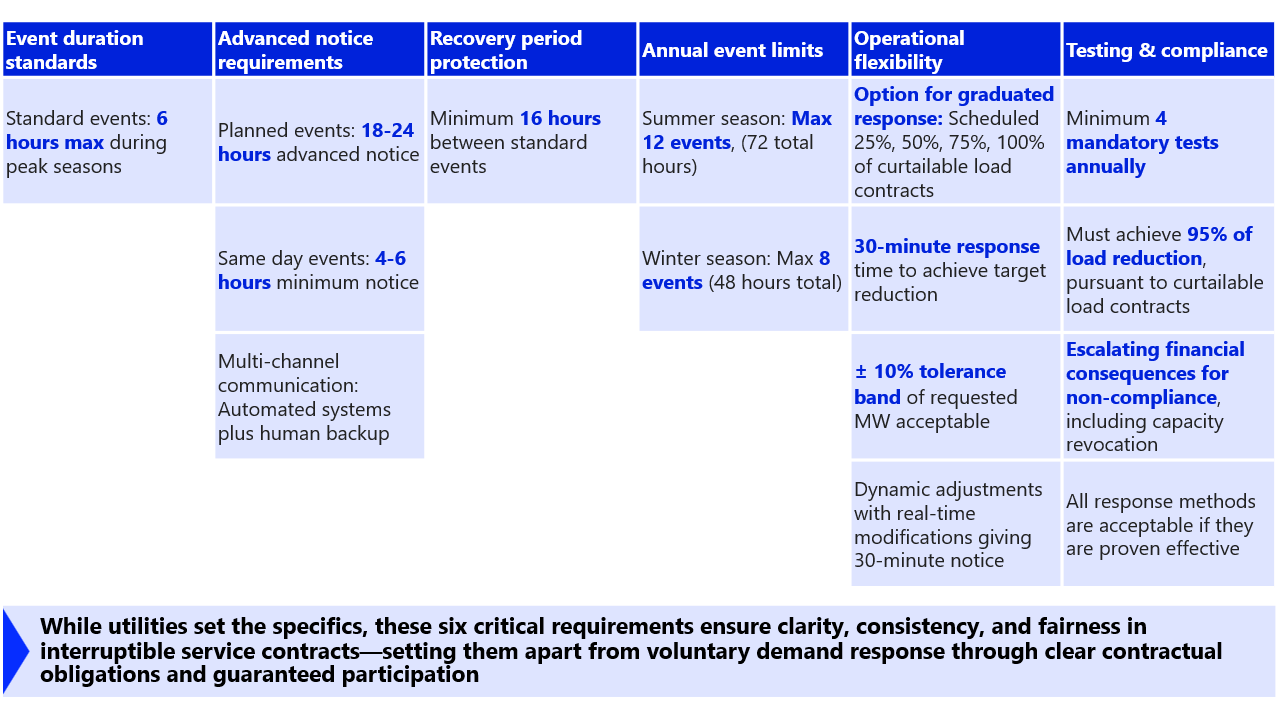
The key difference between an interruptible service contract and a sophisticated demand response program is that load interruptions are non-negotiable once service begins.
Additional Framework Considerations
Beyond the six core requirements in the framework above, successful interruptible service contracts require several additional structural elements:
Economic Structure and Incentives
Baseline establishment: Setting a clear methodology for determining normal operating loads if wildly different from the load’s reserved capacity
Performance bonuses: Additional payments for exceeding curtailment targets or during emergency events
Portfolio aggregation: Ability to combine multiple facilities under a single contract
Market participation rights: Access to wholesale energy and ancillary services markets during curtailment periods
Technical Standards and Integration:
Communication protocols: Standardized interfaces with utility dispatch systems
Metering requirements: Real-time telemetry for facilities over certain thresholds
Grid support capabilities: Voluntary participation in voltage regulation and frequency response
Cybersecurity standards: Protection of critical communication infrastructure
Regulatory and Legal Framework:
Standardized contracts: Model agreements to reduce negotiation time and costs
Dispute resolution mechanisms: Clear processes for handling performance disagreements
Environmental compliance: Coordination with air quality permitting for backup generation
Third-party verification: Independent monitoring for complex curtailment responses
Implementation Timeline: From Concept to Connection
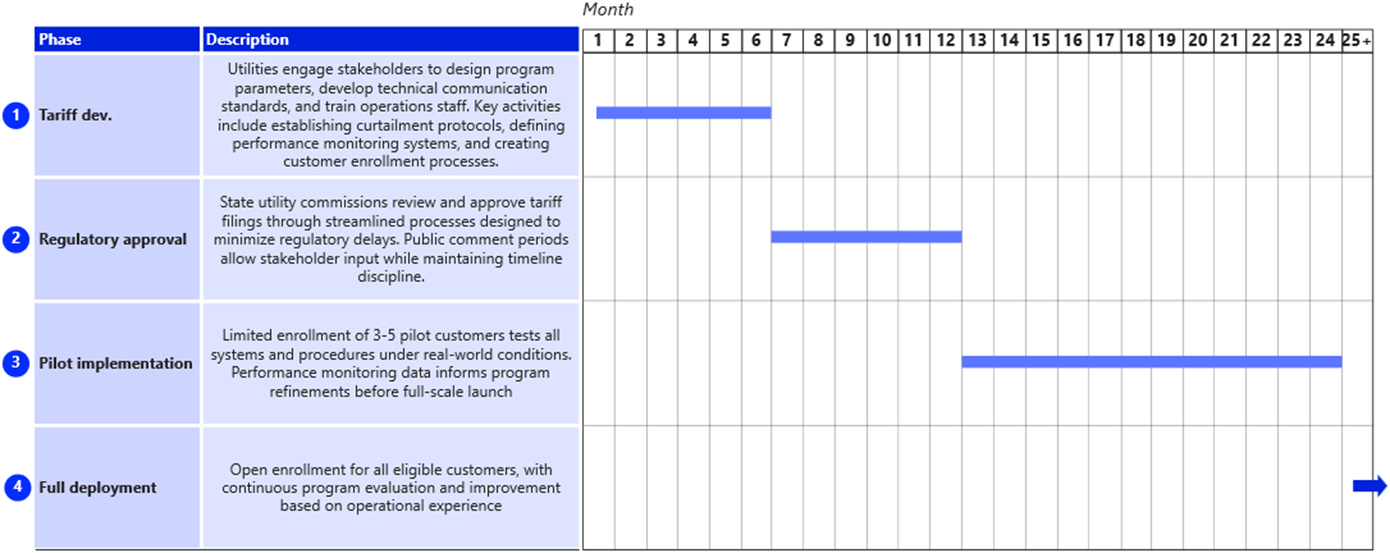
The path to widespread interruptible service programs could follow a proposed four-phase approach, which could grant GWs of capacity to new data center loads nationally without new transmissions assets in ~ 24 months.
The Business Case: Multiple Winners
The economic proposition is compelling for all stakeholders:
Data Center Benefits:
Multi-year reduction in grid connection timelines
Reduced demand, capacity, and energy charges
No new infrastructure costs
Potential wholesale market participation during curtailment
Utility Benefits:
Increase utilization and revenue
Additional dispatchable resources during peak periods
Delay costly transmission upgrades through demand management
Competitive advantage in high-growth markets
Societal Benefits:
Accelerated digital infrastructure deployment
Faster deployment of AI and cloud computing resources
Enhanced demand-side management capabilities
Lower demand for capacity and energy in peak times lowers costs for all based on market-based supply/demand principles
Program implementation costs are assigned to data center customers
Addressing the Skeptics
"Data centers can't curtail operations"
This perspective reflects an outdated understanding of modern facilities. Today's hyperscale data centers routinely operate sophisticated backup generation systems, battery storage arrays, and load management protocols. Many already participate in demand response programs during peak pricing periods, proving that technological solutions for curtailment exist and work.
"Reliability will suffer"
Such concerns ignore the seasonal and limited nature of these programs. With service interruptions occurring only a few times annually, and emergency events providing additional compensation, the actual operational impact is minimal while the grid access benefit is transformational.
"Regulatory complexity will create delays"
This misunderstands the streamlined nature of these programs. By building upon existing interruptible load tariffs and demand response experience and frameworks, utilities can leverage proven regulatory precedents rather than inventing new approval processes.
"Backup generation defeats decarbonization goals"
This view overlooks the broader system benefits and technology flexibility. While some curtailment response may involve fossil generation, the alternative (delayed renewable and low-carbon energy projects due to grid constraints) creates far greater emissions. Moreover, data centers can increasingly rely on battery storage, demand shifting, and clean backup generation to meet curtailment obligations. Additionally, these assets may only run for a few hours a year and have a small impact on overall carbon emissions.
"Utilities will abuse curtailment authority"
Such concerns mischaracterize the contractual protections built into these programs. Strict limits on event frequency, duration, and notice periods prevent overuse, while financial penalties for utility non-compliance (such as inadequate notice) provide strong incentives for responsible program management.
"Data centers will game the system"
This ignores robust performance monitoring and escalating penalty structures. Real-time telemetry, independent verification, and progressive financial consequences for non-compliance create strong incentives for good faith participation.
"Other customers will subsidize data center connections"
This viewpoint reverses the actual cost allocation dynamics. Interruptible service customers pay for their own interconnection facilities and provide grid services during peak periods, reducing system costs for all customers while avoiding the need for ratepayer-funded transmission upgrades.
"Market volatility makes this unworkable"
Such claims underestimate data center operational sophistication. Modern facilities already manage complex cooling systems, backup power arrangements, and workload scheduling. Adding seasonal curtailment management represents an incremental operational challenge, not a fundamental business model shift.
"Safety and security risks are too high"
This conflates curtailment with emergency shutdowns. Planned load interruptions allow orderly load reduction and system stabilization, often providing better operational control than unexpected grid disturbances or equipment failures that occur under current arrangements.
The Path Forward
The data center industry stands at an inflection point. Continued reliance on traditional firm interconnection processes virtually guarantees that critical AI and cloud infrastructure projects will face multi-year or decade-long delays, potentially ceding American technological leadership to countries with more agile grid policies.
Interruptible service contracts offer a proven alternative; one that transforms the current zero-sum game between grid reliability and connection speed into a collaborative framework that serves both objectives. The technology exists, the regulatory precedents are established, and the economic incentives align.
What's needed now is leadership from utility executives willing to embrace innovation, data center operators ready to accept reasonable operational flexibility trading perceived uncertainty for speed, and regulators focused on outcomes rather than process. The companies and regions that move first will capture the competitive advantages of the AI economy. Those who wait will watch opportunity migrate to more forward-thinking markets.
The choice is clear: adapt to the new reality of hyperscale demand, or watch the digital economy route around the bottlenecks we've created. Interruptible service contracts provide the roadmap. The only question remaining: Who will have the courage to follow it?
The views and opinions expressed in this article are those of the authors and are intended to stimulate discussion. They do not constitute legal, financial, or other professional advice.
https://www.woodmac.com/press-releases/with-the-us-data-center-pipeline-surging-regulated-utilities-are-proving-advantaged-in-meeting-demand/
https://www.ercot.com/files/docs/2025/04/08/2025-LTLF-Report.pdf
https://emp.lbl.gov/news/pjm-data-show-substantial-increases
https://nicholasinstitute.duke.edu/articles/us-grid-may-have-over-100-gw-load-spare
https://www.eia.gov/todayinenergy/detail.php?id=65864

https://www.usenix.org/system/files/conference/cooldc16/cooldc16-paper-mcfadden.pdf